Skunked Dog? Remove Odor with This DIY Formula
Yes, skunk smell can be effectively removed from a dog using a homemade solution of hydrogen peroxide, baking soda, and liquid dish soap, which chemically neutralizes the odor-causing compounds. This veterinarian-recommended method oxidizes the sulfur-based thiols in skunk spray into odorless compounds, offering immediate and lasting relief for both you and your furry friend.
⚕️ Veterinary Disclaimer
This article is based on research and professional veterinary guidance, but it does not replace professional veterinary care. If your dog was sprayed directly in the eyes or mouth, shows signs of severe distress, lethargy, weakness, pale gums, or discolored urine, seek immediate veterinary attention. Skunk spray can, in rare cases, cause serious health complications including Heinz body anemia.
Why Skunk Spray Smells So Terrible (And Why It’s So Hard to Remove)
Let me tell you from personal experience—when my Golden Retriever, Bailey, got skunked at 5 AM on a Saturday morning, I thought the smell would never leave our lives. The odor was so overpowering that my eyes watered just standing near her, and I made the rookie mistake of bringing her inside before treating her. Big mistake.
Skunk spray isn’t just any bad smell. According to the American Kennel Club (AKC), the spray contains sulfur-based compounds called thiols (also known as mercaptans), which are the same chemicals added to natural gas to make leaks detectable. These thiols bind to proteins in your dog’s fur and skin, creating an oily, persistent odor that seems to intensify with time and moisture.
What makes skunk spray particularly challenging:
- Oily composition: The spray is oil-based, so it doesn’t wash away with water alone
- Chemical resilience: Thiols resist simple soap and water
- Conversion potential: When wet, thioacetates in the spray can convert into even more pungent thiols
- Penetration depth: The oil seeps deep into fur and skin layers
This is why traditional remedies like tomato juice or plain shampoo simply don’t work—they mask the smell temporarily through olfactory fatigue (your nose gets tired of the smell), but the thiols remain intact.
The Science Behind the Homemade Dog De-Skunking Solution
When Bailey got sprayed, my veterinarian explained exactly why the hydrogen peroxide mixture works where everything else fails. The solution doesn’t just cover up the smell—it chemically transforms it.
How the Chemical Reaction Works
According to PetMD, the hydrogen peroxide acts as an oxidizing agent that breaks down the thiol molecules into sulfonic acids, which are odorless. The baking soda enhances this oxidation process by increasing the pH level, while the dish soap breaks down the oily barrier that protects the thiols.
Here’s the breakdown of each ingredient’s role:
| Ingredient | Amount | Purpose | Why It Works |
|---|---|---|---|
| 3% Hydrogen Peroxide | 1 quart (32 oz) | Primary oxidizing agent | Chemically converts thiols into odorless sulfonic acid compounds |
| Baking Soda | 1/4 cup | pH enhancer and mild abrasive | Raises alkalinity to boost peroxide’s effectiveness; absorbs odors |
| Liquid Dish Soap | 1-2 teaspoons | Surfactant and degreaser | Breaks down the oily skunk spray to allow peroxide penetration |
Critical Note: Never use hydrogen peroxide stronger than 3% household concentration, as higher concentrations can burn your dog’s skin.
Immediate Health Risks: What to Check Before You Start Cleaning
Before I started treating Bailey, my vet walked me through a quick assessment. This is crucial because skunk spray isn’t just smelly—it can be medically dangerous, especially if your dog was sprayed at close range.
Signs Your Dog Needs Immediate Veterinary Care
According to the ASPCA Animal Poison Control Center, watch for these symptoms:
Eye and Face Symptoms:
- Red, swollen, or watery eyes (skunk spray can cause temporary blindness or corneal damage)
- Pawing at the face or eyes continuously
- Visible discharge from eyes or nose
- Squinting or inability to open eyes
Respiratory and Oral Symptoms:
- Excessive drooling or foaming at the mouth
- Difficulty breathing or wheezing
- Persistent sneezing or coughing
- Vomiting or nausea
Serious Warning Signs (Seek Emergency Care Immediately):
- Lethargy or unusual weakness
- Pale, brown, or bluish gums
- Dark or discolored urine (sign of potential Heinz body anemia)
- Collapse or disorientation
When Bailey got sprayed, her eyes were watering badly, so I immediately flushed them with cool water for several minutes before doing anything else. The AKC recommends using a saline solution or plain cool water—never use the peroxide mixture near the eyes.
Understanding Heinz Body Anemia Risk
This is rare, but it’s worth knowing about. If a dog is sprayed heavily in the face and ingests skunk spray, or experiences multiple skunk encounters, the thiols can damage red blood cells, leading to Heinz body anemia. PetMD notes this is more common in cats than dogs, but it can happen, particularly in smaller dogs or puppies.
The Step-by-Step Guide: How to Remove Skunk Smell from Dog
Let me walk you through exactly how I handled Bailey’s skunk encounter, incorporating what I’ve learned from our vet and multiple (unfortunately) subsequent incidents with my other dogs.
Step 1: Contain the Situation (Keep Your Dog Outside)
DO NOT bring your dog inside. I cannot stress this enough. The moment I brought Bailey through the door, the smell permeated our furniture, carpets, and curtains. It took weeks to fully clear our house.
- Keep your dog in the yard or garage
- Put on old clothes you don’t mind throwing away
- Gather your supplies before approaching your dog
- Work in a well-ventilated area
Step 2: Perform a Quick Health Check
Before touching your dog extensively:
- Check the eyes: Look for redness, swelling, or excessive tearing
- Flush eyes if needed: Use cool water or saline solution for 5-10 minutes
- Examine the mouth: Look for excessive drooling or foam
- Watch breathing: Note any difficulty or unusual sounds
- Identify spray location: Determine where the majority of spray hit
If your dog shows any severe symptoms listed earlier, call your veterinarian immediately before attempting cleaning.
Step 3: Prepare Your Supplies and Workspace
What you’ll need:
- Rubber or latex gloves (essential!)
- 1 quart of 3% hydrogen peroxide
- 1/4 cup baking soda
- 1-2 teaspoons liquid dish soap (Dawn works well)
- Large open bucket or container
- Soft washcloths for face
- Towels for drying
- Regular dog shampoo
- Hose or access to warm water
Safety warning from the ASPCA: Mix the solution in an open container only. The chemical reaction between peroxide and baking soda produces oxygen gas, which can cause a closed container to explode. I learned this the hard way when I absentmindedly put a lid on my mixing bowl and it popped off forcefully.
Step 4: Mix the Solution (Right Before Use)
This is where the best way to get skunk smell off dog truly begins. Timing matters here:
- Pour 1 quart of hydrogen peroxide into your open container
- Add 1/4 cup baking soda (it will fizz—this is normal)
- Add 1-2 teaspoons of dish soap and mix gently
- Use immediately—the solution loses effectiveness within minutes
Never prepare this in advance or store leftovers. The oxidation reaction begins immediately, and stored solution can become pressurized and dangerous.
Step 5: Apply to DRY Fur (This Is Critical)
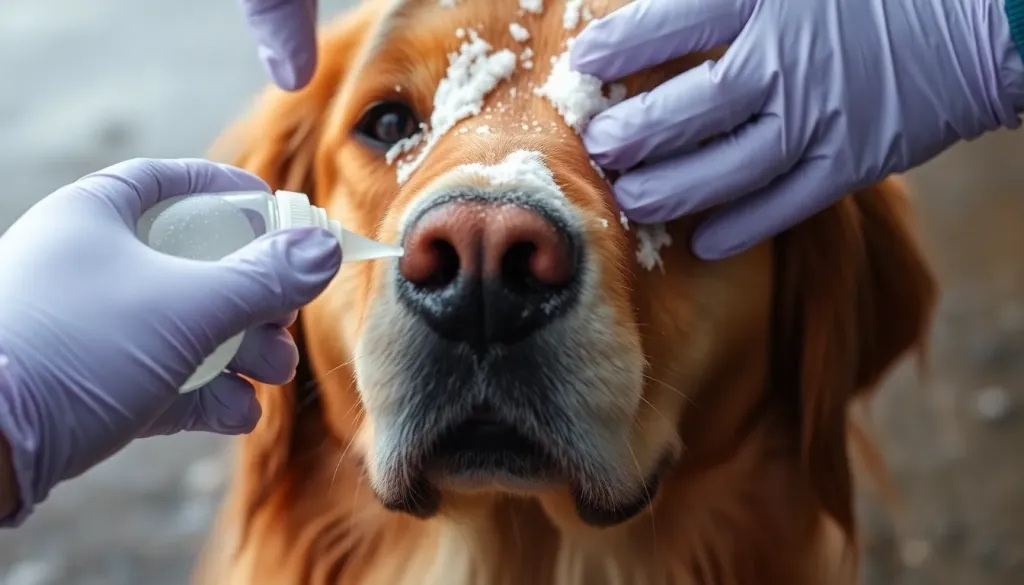
Here’s a mistake I made the first time: I rinsed Bailey with water first, thinking I was helping. Don’t do this. According to veterinary guidance, water can actually make the smell worse by activating thioacetates and spreading the oils.
Application technique:
- Keep your dog’s coat dry
- Put on your rubber gloves (the smell will transfer to your hands)
- Work the solution thoroughly into the fur, focusing on sprayed areas
- Massage down to the skin—don’t just coat the surface
- Avoid eyes, ears, and mouth at all costs
For the face, if it was sprayed:
- Use a damp washcloth saturated with the solution
- Carefully wipe around the muzzle and forehead
- Never pour solution directly on the face
- Keep away from eyes and inside ears
When I treated Bailey’s face, I used a gentle dabbing motion and had my partner help hold her still while speaking soothingly to her.
Step 6: Let It Work Its Magic (But Watch the Clock)
The AKC recommends letting the solution sit for 5 to 10 minutes. Set a timer—I use my phone.
Why timing matters:
- Less than 5 minutes: May not fully oxidize all thiols
- More than 10 minutes: Risk of bleaching fur (especially dark coats) and skin irritation
During this time:
- Keep your dog calm (treats can help if they’re not too stressed)
- Watch for any signs of discomfort or irritation
- Don’t let them shake and spray the solution around
- Monitor their behavior for distress
My chocolate Lab, Duke, has darker fur, and I noticed slight lightening when I left the solution on too long. It grew out eventually, but now I’m strict about the 10-minute maximum.
Step 7: Rinse Thoroughly with Warm Water
After your timer goes off:
- Rinse completely with warm (not hot) water
- Continue rinsing until all traces of solution are gone
- Check for any remaining odor by sniffing different areas
- The wet dog smell might mask the skunk smell initially—this is normal
PetMD advises that thorough rinsing is essential because residual peroxide can cause skin dryness or irritation.
Step 8: Follow Up with Regular Dog Shampoo
This step ensures you remove any remaining residue and restore your dog’s skin’s natural pH balance:
- Apply your regular pet shampoo (oatmeal-based works wonderfully)
- Lather thoroughly across the entire coat
- Rinse completely again
- Towel dry or use a blow dryer on low/cool setting
My dogs absolutely love this part because it means the ordeal is almost over, and they get extra attention and treats.
Step 9: Assess and Repeat If Necessary
After Bailey was dry, I did the “sniff test” in good lighting. If you still detect skunk odor:
- You may need to repeat the process 2-3 times
- Wait at least a few hours between treatments to avoid skin irritation
- Focus on specific areas that still smell rather than the entire dog
- Consider commercial products if homemade solution isn’t fully effective
Important note: Some residual smell is normal for the first 24-48 hours as oils work their way out of deep fur layers.
Step 10: Dispose of Solution Safely
Never store the leftover mixture. I pour any unused solution down an outdoor drain or onto gravel/soil areas away from plants (the peroxide can harm vegetation).
Commercial De-Skunking Products: When to Consider Them
After our third skunk incident (we live near woods, clearly), I invested in commercial de-skunking products as a backup. While the DIY skunk dog bath recipe is most effective, there are times when commercial products make sense.
Best Commercial Options (According to My Experience)
| Product Type | When to Use | Pros | Cons |
|---|---|---|---|
| Nature’s Miracle Skunk Odor Remover | Repeat incidents; indoor contamination | Ready to use; safe for fabrics and surfaces | More expensive; may require multiple applications |
| Skunk-Off | Direct spray situations; travel | Concentrated formula; effective | Strong smell itself; can irritate some dogs |
| Veterinary De-Skunking Shampoos | Sensitive dogs; puppies | Formulated for pets; gentle | Less powerful than homemade solution |
I keep Nature’s Miracle on hand now because it also works on our deck, car interior, and my husband’s work boots (all casualties of Bailey’s skunk encounters).
Why Tomato Juice Doesn’t Work (Despite Grandma’s Advice)
Does tomato juice remove skunk smell? My mother-in-law insisted I try this, and I’m here to tell you from experience: it doesn’t work.
The Truth About Tomato Juice
According to the ASPCA, tomato juice suffers from two major problems:
- It doesn’t neutralize thiols: The acidic tomato juice can’t break down the sulfur compounds chemically
- It causes olfactory fatigue: Your nose temporarily stops detecting the skunk smell because it’s overwhelmed by tomato scent, but the skunk odor is still there
When the tomato smell fades (and it will), the skunk smell returns in full force. Plus, you’ll have a pink-stained dog if they have light fur.
Other Ineffective Remedies to Avoid
Through trial and error (mostly error), here’s what doesn’t work:
- Plain water: Actually spreads the oils and can intensify the smell
- Regular dog shampoo alone: Can’t break down thiols without oxidation
- Vinegar: Masks temporarily but doesn’t neutralize (though it’s safer than some alternatives)
- Household bleach: Dangerous for pets and doesn’t effectively remove skunk spray
- Ammonia: Toxic to dogs and ineffective against skunk odor
- Perfumes or air fresheners: Just creates a horrible combination smell
Dealing with Skunk Smell Dangers for Dogs: Long-Term Considerations
The immediate crisis passes, but there are lingering concerns I’ve learned to address.
Preventing Future Encounters
After our multiple incidents, our family took these preventive steps:
Yard Management:
- Install motion-activated lights near potential den areas
- Remove food sources (secure garbage, clean up fallen fruit)
- Close off spaces under decks, sheds, and porches
- Keep dogs on leash during dawn/dusk hours (peak skunk activity)
Behavioral Training:
- Teach strong recall commands
- Reward your dog for checking in during evening walks
- Use a long training lead in areas where skunks are present
Seasonal Awareness:
- Spring and fall are peak skunk activity periods
- Skunks are most active during breeding season (late winter/early spring)
- Stay extra vigilant if your area has a known skunk population
Indoor Contamination: What to Do
If your dog made it inside before treatment (like Bailey did), you’ll need to tackle your home:
For Fabrics and Upholstery:
- Spray with commercial enzymatic cleaner or diluted peroxide solution (test first!)
- Blot—don’t rub—to avoid spreading oils
- Wash removable items in hot water with a cup of baking soda
- Consider professional cleaning for severe contamination
For Hard Surfaces:
- Wipe down with diluted peroxide solution (1:1 with water)
- Clean thoroughly with enzymatic cleaner
- Ventilate rooms extensively
Our couch took two professional cleanings before the smell fully left. Now I have washable covers on everything.
Skunk Spray Dangers for Dogs: When Complications Arise
While most dogs recover quickly after de-skunking, some situations require ongoing veterinary care.
Monitoring for Delayed Reactions
Watch your dog for 48-72 hours after the incident for:
- Changes in appetite or behavior
- Persistent eye irritation or discharge
- Respiratory issues (coughing, wheezing)
- Gastrointestinal upset
- Skin reactions (redness, hives, excessive scratching)
Bailey developed mild conjunctivitis two days after her first skunking, requiring antibiotic eye drops from our vet.
Multiple Exposure Concerns
If your dog has been skunked multiple times (hello, Duke), discuss with your veterinarian about:
- Baseline bloodwork: To check for early signs of anemia
- Behavior modification: To reduce future encounters
- Property assessment: To identify why skunks are attracted to your area
FAQ: Your Burning Questions About Skunk Spray Removal
How long does skunk smell last on a dog if untreated?
From painful experience, I can tell you that untreated skunk smell can linger for weeks or even months. The oils in skunk spray are incredibly persistent. Even after the initial intense smell fades, the odor can resurface when your dog’s fur gets wet—Duke smelled like skunk for weeks afterward every time it rained or after baths, because we didn’t treat him properly the first time. This is why immediate treatment with the proper homemade dog de-skunking solution is so critical. The hydrogen peroxide mixture chemically neutralizes the thiols, while simply waiting for the smell to fade naturally leaves those compounds intact in your dog’s coat. According to PetMD, environmental factors like humidity can actually reactivate the smell from residual oils even after you think it’s gone.
Can I use the skunk removal solution on puppies or dogs with sensitive skin?
This is a great question I asked my vet before treating my younger dog. Yes, you can use the hydrogen peroxide solution on puppies, but with extra precautions. The AKC recommends being even more careful with application around sensitive areas, using a lower concentration of dish soap (just 1 teaspoon instead of 2), and reducing the sit time to 5 minutes maximum instead of 10. For dogs with sensitive skin, known allergies, or existing skin conditions, I’d recommend testing a small area first or consulting your veterinarian about potentially gentler commercial alternatives. When I treated my puppy after her first (and thankfully only) skunk encounter, I diluted the solution slightly with water and kept the contact time brief—it still worked effectively. For very young puppies (under 8 weeks), always consult your veterinarian first, as their skin is more delicate and they’re more susceptible to toxicity from ingesting the solution while grooming themselves afterward.
What should I do if the skunk smell returns after bathing my dog?
This happened with Bailey, and it’s frustratingly common. When skunk smell returns after treatment, it usually means one of three things: (1) you didn’t thoroughly rinse all the skunk oil from deep in the coat, especially around the neck and tail base where oil concentration is highest; (2) your dog has an undercoat that trapped the oils and needs a second treatment specifically targeting those areas; or (3) environmental contamination—the smell is actually on your dog’s collar, bedding, or in areas where they’ve rubbed against things. According to the ASPCA, residual thioacetates can convert back into smelly thiols when exposed to moisture. My solution: First, identify where the smell is strongest by doing a thorough sniff test on different body parts. Then, prepare a fresh batch of the peroxide solution and do a targeted spot treatment on those specific areas. Don’t forget to check and clean your dog’s collar, harness, bedding, and any favorite lounging spots. With Bailey, the smell kept returning because her collar was contaminated—once I replaced it and did one more targeted treatment on her neck area, the problem was solved. If the smell persists after 2-3 proper treatments, consider a commercial enzymatic de-skunker or consult your veterinarian, as there might be an underlying skin condition trapping the odors.
Final Thoughts from a Multi-Skunk Battle Veteran
Living with multiple dogs in an area with an active skunk population has taught me more about skunk spray than I ever wanted to know. But through four separate incidents (yes, four), I’ve refined my approach to a science.
The most important lessons I’ve learned:
- Act immediately: Every minute counts before the oils set deeper into fur
- Don’t panic: Your dog is feeding off your energy
- Preparation is everything: Keep supplies on hand if you live in skunk territory
- Prevention beats cure: Invest in deterrents and yard management
The homemade dog de-skunking solution genuinely works—when I use it properly and immediately, my dogs smell completely normal within 24 hours. But those first few times, when I made mistakes like rinsing first or not being thorough enough, I paid the price with lingering odors and repeated treatments.
Remember, this is a temporary crisis that feels overwhelming in the moment but passes. Your dog isn’t permanently damaged (unless there are eye or health complications requiring vet care), your house will eventually stop smelling, and yes, your dog will forgive you for the chemical bath.
Now I keep a “skunk kit” in my garage—a pre-labeled container with a bottle of hydrogen peroxide, a box of baking soda, and dish soap, plus rubber gloves and old towels. Our family jokes that we’re skunk-spray experts now, though I’d happily give up that expertise for no more 5 AM emergency baths.
Stay prepared, stay calm, and remember: this too shall pass (unlike the smell, if you don’t treat it properly).