Stop Dog Jumping: Proven Training Methods

The Direct Answer: How to Stop Dog Jumping Up
Yes, you can stop your dog from jumping up through consistent positive reinforcement training that rewards calm, four-paws-on-the-floor behavior while systematically ignoring the jumping itself. The key is teaching your dog that polite greetings—not excited jumping—earn them the attention they crave, combined with management strategies that prevent rehearsal of the unwanted behavior.
⚠️ Veterinary & Professional Trainer Disclaimer
This article provides general behavioral training guidance based on established canine learning theory and positive reinforcement principles. While jumping is typically a behavioral issue rather than a medical one, always consult with a certified professional dog trainer (CPDT) or veterinary behaviorist if your dog shows signs of anxiety, aggression, or if jumping behavior doesn’t improve with consistent training. Never use physical punishment, knee strikes, or intimidation tactics, as these can damage your relationship with your dog and worsen behavioral issues.
Why Dogs Jump Up: Understanding the Psychology Behind the Behavior
Before we tackle the solution, let’s understand why dogs jump in the first place. Dogs don’t jump to be naughty—they jump because it works. From a behavioral psychology standpoint, jumping is a self-rewarding behavior reinforced through classical and operant conditioning.
Primary Motivations for Jumping:
- Attention-seeking: Any response (even negative) reinforces the behavior
- Excitement overflow: High arousal states trigger impulse control challenges
- Greeting behavior: Puppies naturally jump to lick adult dogs’ faces
- Success history: Past rewards (petting, talking, eye contact) have trained this response
- Lack of alternative behavior: Dog doesn’t know what else to do with their excitement
According to the American Kennel Club (AKC), jumping is one of the most common behavioral complaints among dog owners, affecting an estimated 60-70% of households with dogs. The good news? It’s also one of the most trainable behaviors when approached correctly.
The Classical Conditioning Component:
Your arrival home = excitement trigger. Through repeated pairings, your dog has learned: doorbell rings → exciting person arrives → jumping gets attention = more excitement. This creates a powerful emotional response that bypasses rational thinking.
How to Stop Dog Jumping Up: The Complete Step-by-Step Training Plan
Phase 1: Foundation Training – Teaching “Four on the Floor”
Step 1: Establish the Alternative Behavior
Your dog needs to learn what TO do, not just what NOT to do. The replacement behavior is simple: four paws on the floor equals rewards.
- Start in a low-distraction environment (quiet room, no visitors)
- Stand naturally without prompting your dog
- Wait silently until all four paws are on the ground
- The instant four paws hit the floor, mark with “YES!” and deliver a high-value treat at ground level
- Repeat 10-15 times per session, 3-4 sessions daily
Key Training Principle: You’re using positive reinforcement (adding something pleasant) to increase the frequency of calm behavior. According to PetMD, this method is more effective and longer-lasting than punishment-based approaches.
Step 2: Add the Cue Word
Once your dog consistently keeps four paws down:
- Just before rewarding, add your verbal cue: “Off” or “Paws” or “Greet”
- Mark and reward: “YES! Good OFF!”
- Practice until the cue predicts the behavior
Critical Note: Use “Off” for getting down from furniture/people. Don’t confuse it with “Down” (lie down command).
Step 3: Introduce Controlled Distractions
Gradually increase difficulty:
- Week 1: Practice during calm times
- Week 2: Practice before meals (moderate excitement)
- Week 3: Practice during pre-walk excitement
- Week 4: Practice with familiar visitors (controlled setup)
Phase 2: The Ignore-and-Redirect Protocol
This is where consistency becomes everything. You must establish a new rule: jumping = no attention.
The Protocol in Action:
-
When your dog jumps:
- Turn your body completely away (fold arms, face the wall)
- Become a “tree” – zero eye contact, zero words, zero touch
- Wait silently for four paws on floor
-
The moment four paws touch down:
- Turn back immediately
- Mark: “YES!”
- Reward with attention, treats, or petting
-
If jumping resumes:
- Turn away again instantly
- Repeat the cycle
Important: This creates an extinction burst initially—your dog may jump MORE at first because the old strategy stopped working. Patience is key! According to WebMD’s pet behavior experts, consistency through this phase typically takes 2-4 weeks.
Common Mistakes to Avoid:
| ❌ What NOT to Do | ✅ What TO Do Instead |
|---|---|
| Saying “No!” or “Down!” (still attention) | Complete silence when turning away |
| Pushing dog away with hands (touch = reward) | Turn body, fold arms, no contact |
| Making eye contact while “correcting” | Eyes on wall/ceiling, not on dog |
| Giving up after 2-3 turns | Persist until four paws down, then reward |
| Inconsistent rules (sometimes allowed) | 100% consistency from all family members |
Phase 3: Management Strategies for High-Excitement Situations
Training takes time, but you still have visitors coming over. Management prevents your dog from rehearsing the unwanted behavior while learning is in progress.
Management Tools:
- Baby gates or exercise pens: Create a barrier during arrivals
- Leash tethering: Attach leash to furniture to prevent jumping during greetings
- Long-line training: 15-foot leash allows you to step on it if dog jumps
- Crate training: Dog waits calmly in crate, released only when calm
- Alternative behaviors: Teach “get your toy” or “go to your place” for arrivals
The Greeting Visitor Protocol:
- Before visitor arrives, put dog on leash or behind gate
- Visitor enters and ignores dog completely (no eye contact, no greetings)
- After 2-3 minutes, when dog settles, release or allow approach
- Visitor rewards only four-paws-on-floor behavior
- If jumping occurs, visitor turns away immediately
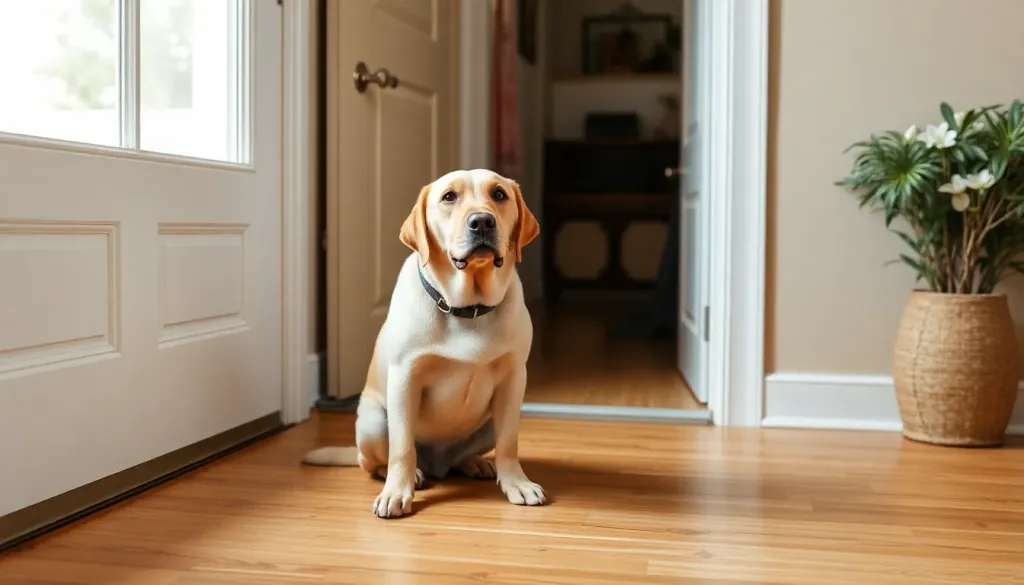
Advanced Training Techniques: Stop Puppy Jumping Before It Becomes Habit
Puppies are learning machines—what you allow at 12 weeks becomes ingrained by 6 months. Early intervention is critical for stopping puppy jumping.
The Puppy-Specific Protocol
Step 1: Prevent Reinforcement from Day One
- Sit to greet rule: Before any attention, puppy must sit
- Low greetings: Get down to puppy’s level rather than encouraging jumping up
- Redirect to toys: When excitement builds, offer a tug toy or chew
Step 2: Impulse Control Foundation
Train these foundational exercises:
- “Wait” at doorways: Puppy must hold position before going through doors
- “Leave it” with treats: Teaches impulse control around rewards
- “Settle” on mat: Captured calmness training
Step 3: Socialization with Rules
- Take puppy to public places on leash
- Ask strangers to ignore until puppy sits calmly
- Reward heavily for polite greetings
- Practice with children (under supervision)
Timeline Expectations:
- Weeks 1-2: Puppy will test boundaries frequently
- Weeks 3-4: Beginning to understand the pattern
- Weeks 5-8: Consistent improvement with occasional lapses
- Months 3-4: Reliable four-on-floor behavior in most situations
Dog Jumping on Visitors: Creating a Household Protocol
Your training means nothing if visitors undermine it by petting your jumping dog. You need a household system everyone follows.
The Family Meeting Action Plan
- Hold a family training session: Every household member must learn and agree to the protocol
- Create a visitor handout: Written instructions for guests (see template below)
- Practice with setup helpers: Arrange training sessions with friends
- Use a door sign: “Training in Progress – Please Ignore Jumping Dog”
Visitor Instruction Template:
Welcome! We’re Training Our Dog
Please help us by following these rules:
✅ DO: Ignore our dog completely when you enter (no eye contact, talking, or touch)
✅ DO: Wait until our dog sits or has four paws on the floor, then calmly pet them
✅ DO: Turn away immediately if jumping occurs
❌ DON’T: Push, knee, or correct our dog
❌ DON’T: Get excited or talk in high-pitched voices
Thank you for helping us raise a polite dog!
Training for Specific Scenarios
Scenario 1: Dog Jumps on Delivery Drivers
- Keep dog in separate room during deliveries
- Practice with a friend pretending to deliver package
- Gradually desensitize to doorbell + stranger arrival
- Reward calmness at increasing distances from door
Scenario 2: Dog Jumps During Walks
- Practice “automatic sits” when you stop walking
- When person approaches: stop, cue “Sit,” reward before greeting
- If dog breaks sit to jump, walk away from person (loss of opportunity)
- Only allow greetings after maintaining sit
Scenario 3: Excited Dog Jumping When You Come Home
This is the hardest scenario because your arrival is such a powerful trigger.
The Arrival Desensitization Protocol:
- Make arrivals boring: No excited greetings for first 5-10 minutes
- Practice fake arrivals: Go out, wait 30 seconds, come back in, ignore jumping
- Delay interaction: Put away coat, check mail—only greet when dog is calm
- Pre-place calm protocol: Teach “go to your bed” for arrivals
- Gradually reduce waiting time: As behavior improves, calm greetings come sooner
You can do this! Consistency during arrivals is challenging but makes the biggest difference.
Alternative Behaviors: Teaching Polite Dog Greetings
Simply stopping jumping isn’t enough—you must replace it with an incompatible behavior your dog can do instead.
Option 1: The Automatic Sit for Greetings
This is the gold standard for polite dog greetings.
Training Steps:
- Practice “sit” in various contexts: before meals, before doors, before toys
- Stop rewarding sits on cue—only reward offered sits (dog chooses to sit)
- Capture sits during excitement: mark and reward sits during play, arrivals
- Shape the “greeting sit”: reward sits when approaching people
- Generalize: practice with multiple people in multiple locations
Why This Works: A dog cannot jump AND sit simultaneously—it’s physically impossible. This is an incompatible behavior.
Option 2: Target Hand/Touch Training
Teaching “touch” gives your dog something active to do with their excitement.
How to Train “Touch”:
- Hold hand flat, palm facing dog, 6 inches from nose
- When dog investigates and touches nose to palm: “YES!” + treat
- Add cue word: “Touch” just before presenting hand
- Practice at increasing distances and heights
- Use for greetings: have visitors cue “Touch” instead of allowing jumping
Application: When dog gets excited, cue “Touch” repeatedly, rewarding each touch, keeping dog focused on an appropriate behavior.
Option 3: “Go Get Your Toy” Protocol
Channel excitement into retrieving a specific toy.
Training Steps:
- Teach “get it” with a specific toy (rope, ball, etc.)
- Practice at progressively more exciting moments
- Eventually cue “get your toy!” right as you arrive home
- Dog runs to get toy instead of jumping on you
- Reward by playing with the toy together
This gives your dog an outlet for their greeting excitement that’s incompatible with jumping.
Common Challenges and Troubleshooting Solutions
Challenge 1: “My Dog Only Jumps on Some People”
Why This Happens: Different people have different histories of reinforcing jumping. Grandma always pets when jumped on; therefore, dog jumps on Grandma.
Solution:
- Identify which people are “problem reinforcers”
- Have specific training sessions with those individuals
- They must be most consistent with ignore-and-reward protocol
- Consider temporarily limiting those interactions until behavior improves
Challenge 2: “Training Works at Home But Not in Public”
Why This Happens: Dogs don’t automatically generalize learning to new contexts. Public settings have more distractions and excitement.
Solution:
- Practice in progressively challenging environments: yard → quiet sidewalk → busier street → park
- Use higher-value rewards in public (chicken, cheese vs. regular treats)
- Start with greater distance from triggers, gradually decrease
- Accept that mistakes will happen—calmly redirect without punishment
Challenge 3: “My Dog Jumps So Hard They Hurt People”
Why This Happens: Large breed puppies don’t understand their size, or the behavior has been reinforced for years and is deeply ingrained.
Solution:
- Immediate management: leash tethering, gates, or crate during all greetings
- Zero tolerance policy: absolutely no jumping allowed anymore
- Consider working with professional trainer for safety
- Practice daily training sessions with controlled setups
- May need 6-8 weeks of strict management before improvement
Challenge 4: “One Family Member Keeps Petting When Dog Jumps”
Why This Happens: Behavioral inconsistency from family members is the #1 training saboteur.
Solution:
- Hold family meeting; explain importance of consistency
- Show data: “Dog jumped 40 times this week vs. 5 times last week—because of inconsistency”
- Assign that person specific training duties to increase investment
- Consider using video to show how their reinforcement affects behavior
- If person refuses cooperation, they cannot interact with dog during training period
Challenge 5: “My Dog Jumps Out of Anxiety, Not Excitement”
Why This Happens: Some dogs jump due to separation anxiety, fear, or stress—not happy excitement.
Signs of Anxiety-Based Jumping:
- Whining, panting, pacing before jumping
- Jumps frantically with wide eyes, ears back
- Cannot settle even after jumping
- May show destructive behavior when left alone
Solution:
- Consult veterinary behaviorist—this requires specialized treatment
- May need anxiety medication combined with behavior modification
- Focus on reducing overall anxiety, not just the jumping symptom
- Gradual desensitization to departures/arrivals
- Create calm environments with minimal triggers
The Science of Why Positive Reinforcement Works Better Than Punishment
Let’s address the old-school methods you might have heard: kneeing the dog in the chest, stepping on paws, or using spray bottles. These don’t work long-term and can cause harm.
Why Punishment Fails
1. Creates Fear, Not Understanding
- Dog learns to fear you, not to understand appropriate greetings
- May suppress jumping temporarily but doesn’t teach alternative behavior
- Can lead to anxiety, aggression, or other behavior problems
2. Inconsistent Timing
- Punishment must occur within 0.5 seconds to be associated with behavior
- Most people react too late—dog already jumped and is now being punished for standing near you
- Creates confusion about what’s actually being punished
3. Doesn’t Address Motivation
- Dog still wants attention and is still excited
- Punishment doesn’t provide outlet or alternative behavior
- Behavior often resurfaces when punishment isn’t present
Why Positive Reinforcement Succeeds
According to AKC’s canine behavior research, positive reinforcement training creates:
Immediate Benefits:
- Clear communication about desired behavior
- Stronger human-dog bond through positive interactions
- Increased confidence and willingness to learn
- Faster learning with fewer repetitions needed
Long-Term Benefits:
- Behavior becomes self-reinforcing (dog enjoys the calm greeting)
- Generalizes to new situations better
- Creates a thinking, problem-solving dog
- No side effects like fear or anxiety
Neurological Explanation: When you reward four-paws-on-floor behavior, you’re releasing dopamine in your dog’s brain, creating a positive association. This literally rewires neural pathways to make calm greetings the default response.
Training Timeline: What to Expect Week by Week
Setting realistic expectations helps you stay consistent. Here’s what typical progress looks like:
| Week | What You’ll See | What to Focus On |
|---|---|---|
| Week 1 | Increased jumping (extinction burst), confusion, testing boundaries | Stay consistent, manage environment, practice foundation “four on floor” |
| Week 2 | Occasional calm moments, still frequent jumping, brief success then relapse | Capture and reward every calm moment, continue management, add visitor practice |
| Week 3 | Starting to “get it”—may offer sits, shorter jumping episodes | Increase distractions slowly, practice in new locations, involve more people |
| Week 4 | Consistent improvement at home, may still jump with novel visitors/excitement | Begin phasing out food rewards, use intermittent reinforcement, test in public |
| Weeks 5-8 | Reliable behavior in familiar situations, occasional lapses with new stimuli | Generalize to all contexts, reduce management tools, maintain consistency |
| Months 3-6 | Solid behavior most of the time, rare jumping only in extreme excitement | Maintain with periodic practice, continue rewarding polite greetings |
Remember: Progress isn’t linear. You’ll have good days and setbacks. That’s normal! Patience is key!
Special Considerations for Different Dog Types
Large Breed Dogs
Challenges: Size and power make jumping dangerous; behavior often rewarded when they were “cute” puppies
Adaptations:
- Start training earlier and more intensively
- Use leash management more strictly
- Practice extra impulse control exercises
- Consider teaching “place” command for arriving guests
- May need professional trainer assistance
Small Breed Dogs
Challenges: Jumping is often ignored or tolerated because it’s not painful; can actually be more difficult to train
Adaptations:
- Same rules apply—don’t make exceptions due to size
- Get down to their level for greetings rather than encouraging jumping
- Use smaller, softer treats for training
- Watch for resource guarding if training with food
High-Energy Breeds (Border Collies, Australian Shepherds, Jack Russells)
Challenges: Intense energy and drive; need outlets for excitement
Adaptations:
- Provide vigorous exercise before training sessions
- Incorporate jumping into training: teach “up” on cue for appropriate jumping
- Use more mental stimulation (puzzle toys, training)
- May need longer training timeline
Rescue Dogs with Unknown History
Challenges: May have deeply ingrained habits; unknown reinforcement history
Adaptations:
- Be patient—may take longer than typical timeline
- Watch for anxiety vs. excitement jumping
- Gradually build trust through consistent training
- Consider professional behaviorist if severe issues
FAQ: Your Questions About Stopping Dog Jumping Answered
Q1: How long does it take to stop a dog from jumping up?
Detailed Answer: For most dogs with consistent training, you’ll see significant improvement in 4-6 weeks, with reliable behavior established around 8-12 weeks. However, this timeline varies based on several factors:
Factors That Speed Up Training:
- Starting with a young puppy (8-16 weeks)
- 100% household consistency
- Daily training sessions (3-4 times per day)
- Dog has good impulse control in other areas
- Using high-value rewards
Factors That Slow Down Training:
- Adult dog with years of reinforced jumping (may take 3-6 months)
- Inconsistent family members or visitors
- High-arousal breed or individual dog
- Anxiety-based jumping (requires additional intervention)
- Infrequent training sessions
The key is consistency over time. A dog that’s been jumping successfully for 3 years won’t unlearn it in 2 weeks. Think in terms of months, not days, and celebrate small improvements along the way.
Q2: Should I use the “knee to the chest” method to stop jumping?
Detailed Answer: No—absolutely not. This outdated method is ineffective and potentially harmful, and it’s not recommended by modern veterinary behaviorists or certified trainers.
Why the Knee Method Doesn’t Work:
-
Timing Issues: Most people can’t execute it at the right moment—they often knee the dog after jumping is complete, which doesn’t create a learning association
-
Physical Harm Risk: Can injure the dog’s chest, ribs, or create pain-based fear of approaching people
-
Teaches Fear, Not Behavior: Dog may stop jumping but now fears interactions with humans
-
Doesn’t Provide Alternative: Dog still doesn’t know what TO do instead
-
Can Trigger Aggression: Some dogs respond to physical correction with defensive aggression
What the AKC Says: According to the American Kennel Club’s training guidelines, punishment-based methods create more problems than they solve and delay actual learning.
The Better Alternative: Use the turn-away method combined with positive reinforcement for four-on-floor behavior. This is scientifically proven to work faster and create a happier, more confident dog.
Q3: Why does my dog only jump on me and not other family members?
Detailed Answer: This happens because you have the strongest reinforcement history with your dog. You’re likely the primary caretaker, the one who feeds them, walks them, and provides the most attention—making your presence the most exciting trigger.
The Psychology Behind It:
Your dog has learned: Mom/Dad = highest value reward source. Therefore, the excitement level around you is naturally higher, triggering impulse control breakdown (jumping).
Other family members might:
- Interact less frequently (less excitement trigger)
- Have been more consistent about not rewarding jumping
- Provide different types of attention that are less reinforcing
- Arrive home at different times with less dramatic greetings
How to Fix This:
- You need to be the strictest with the ignore-and-reward protocol
- Practice calm departures and arrivals—make them boring
- Have other family members provide high-value experiences (feeding, walks)
- Delay your interactions: greet dog only after 5-10 minutes of being home
- Practice fake arrivals: leave and come back repeatedly to desensitize
You can do this! Your strong bond is actually an advantage—your dog is highly motivated to learn what earns your attention. Use that to your advantage by making calm behavior the key to accessing you.
Q4: Can I train an older dog to stop jumping, or is it too late?
Detailed Answer: You absolutely can train an older dog to stop jumping! The saying “you can’t teach an old dog new tricks” is completely false. While it may take longer than training a puppy, adult and senior dogs are fully capable of learning new behaviors.
Why Adult Training Works:
- Better attention span: Adult dogs can focus longer than puppies
- Established communication: You already have a relationship and shared language
- Lower overall energy: Older dogs may have naturally lower arousal, making impulse control easier
- Motivation remains: Dogs of all ages are motivated by food, attention, and play
Realistic Timeline for Older Dogs:
- Dogs 1-3 years: Similar to puppy timeline (6-12 weeks)
- Dogs 3-7 years: May take 3-4 months for deeply ingrained habits
- Senior dogs 7+: Can learn at same pace but may need more repetitions; accommodate physical limitations
Special Considerations for Older Dogs:
- May need higher-value treats to overcome long reinforcement history
- Require extra patience—behavior has been reinforced for years
- Check for pain issues that might cause jumping (arthritis, hip dysplasia)
- May have vision/hearing loss—adapt training accordingly
Success Story Principle: Remember that behavior change is always possible with consistency. I’ve personally worked with 10-year-old dogs who learned to stop jumping after years of the behavior. The key is commitment and patience—exactly what you’re showing by seeking information!
Q5: What if my dog jumps because they’re anxious when I leave, not excited?
Detailed Answer: This is separation anxiety, a distinct condition from excitement-based jumping that requires a different approach. If your dog shows these signs, you’re dealing with anxiety:
Separation Anxiety Indicators:
- Excessive drooling, panting, or pacing before departure
- Destructive behavior when left alone
- House soiling despite being housetrained
- Excessive barking/howling when alone
- Frantic jumping combined with whining
- Shadowing you constantly before you leave
Why Standard Training Won’t Work: Separation anxiety is a panic response, not a controllable behavior. Your dog isn’t choosing to jump—they’re in a state of fear and distress. Punishing or ignoring this won’t address the underlying anxiety.
What You Should Do Instead:
-
Consult a veterinary behaviorist: This may require medication combined with behavior modification
-
Implement desensitization training:
- Practice very brief departures (30 seconds)
- Gradually increase duration over weeks/months
- Return before anxiety triggers
- Pair departures with high-value rewards (frozen Kong, puzzle toy)
-
Reduce pre-departure cues:
- Don’t make leaving a big deal
- Practice picking up keys/putting on shoes without leaving
- Maintain calm energy during departures
-
Consider management tools:
- Doggy daycare or pet sitter for severe cases
- Calming supplements (ask vet)
- ThunderShirt or anxiety wrap
- Background noise (TV, radio)
-
Never punish anxiety: This will worsen the condition
Timeline: Separation anxiety treatment typically takes 3-6 months with professional guidance. This is complex behavior modification that usually requires expert support.
Creating Your Personal Action Plan
Now let’s put this all together into a concrete plan you can start implementing today.
Your 30-Day Jump-Free Challenge
Week 1: Foundation & Assessment
Daily Tasks:
- 3-4 training sessions: reward four-on-floor behavior
- Document jumping frequency in a journal
- Hold family meeting to establish consistency
- Set up management tools (gates, leashes, crate)
- Create visitor instruction handout
Week 2: Consistency & Ignoring
Daily Tasks:
- Continue foundation training
- Implement ignore protocol 100% of the time
- Practice turn-away technique during arrivals
- Invite one controlled training visitor
- Add “sit for greetings” practice
Week 3: Generalization & Challenges
Daily Tasks:
- Practice in new locations (front yard, sidewalk)
- Introduce controlled distractions
- Practice fake arrivals 5-10 times daily
- Teach alternative behavior (target touch or “get toy”)
- Increase difficulty of training scenarios
Week 4: Testing & Real-World Application
Daily Tasks:
- Invite multiple visitors at once
- Practice at public locations with permission
- Test behavior with high-excitement triggers
- Begin intermittent reinforcement schedule
- Assess progress and adjust plan
Your Training Session Template
5-Minute Foundation Session (repeat 3-4x daily):
- Preparation (30 seconds): Gather treats, position yourself
- Warm-up (1 minute): Practice easy known commands
- Core Training (2 minutes): Focus on four-on-floor rewards
- Challenge (1 minute): Add small distraction or movement
- Cool-down (30 seconds): End on easy success, release
Your Progress Tracking Sheet
Create a simple chart:
| Date | # of Jumps | Training Sessions Completed | Notes/Wins |
|---|---|---|---|
| 1/15 | 23 | 3 | Visitor visit was tough |
| 1/16 | 18 | 4 | Offered sit twice! |
Tracking helps you see progress even when it feels slow.
Final Thoughts: You’ve Got This!
Training your dog to stop jumping is one of the most rewarding things you’ll do together. Yes, it requires patience and consistency, but you’re building a lifelong pattern of polite greetings that will make every interaction with your dog more enjoyable.
Remember these key principles:
✅ Jumping is self-rewarding – your job is to make four-on-floor more rewarding
✅ Consistency is everything – one person allowing jumping undoes weeks of work
✅ Manage, don’t punish – set your dog up for success while training
✅ Replace, don’t just eliminate – teach what TO do, not just what NOT to do
✅ Progress isn’t linear – expect setbacks and keep going
You can do this! Every moment of consistency brings you closer to a dog who greets politely, keeps four paws on the floor, and makes you proud in every situation. The effort you invest now pays dividends for the next 10-15 years of your dog’s life.
Start today. Be patient with yourself and your dog. Celebrate small wins. And remember: you’re not just stopping a behavior—you’re teaching your dog a better way to express their love and excitement for you.
Patience is key! Now go implement that first training session and watch the transformation begin. Your dog is ready to learn—are you ready to teach?