Stop Leash Reactivity: Calm Walks for Your Dog
Direct Answer: Can You Stop Dog Reactivity on Leash?
Yes, leash reactivity in dogs can be successfully managed and significantly reduced through consistent positive reinforcement training, strategic environmental management, and patience. With the right approach—including desensitization, counter-conditioning, and teaching your dog alternative behaviors—you can transform stressful walks into enjoyable bonding experiences for both you and your four-legged friend.
Veterinary Disclaimer
Important Notice: While this article provides comprehensive training guidance for leash-reactive dogs, every dog is unique. If your dog shows aggressive behaviors, has bitten or attempted to bite, or displays severe anxiety, please consult with a certified professional dog trainer (CPDT-KA), a board-certified veterinary behaviorist (DACVB), or your veterinarian. Some dogs may benefit from behavioral medication in conjunction with training. This article is for educational purposes only and does not replace professional evaluation.
Understanding Leash Reactivity: What’s Really Happening
Leash reactivity—the explosive barking, lunging, growling, or pulling that occurs when your dog encounters triggers while on leash—is one of the most frustrating behavioral challenges dog owners face. Here’s the good news: your dog isn’t “bad” or “aggressive.” According to the ASPCA Professional, leash reactivity typically stems from fear, frustration, or a combination of both, not from dominance or a desire to attack.
Fear vs. Frustration Reactivity: Know the Difference
Understanding the root cause of your dog’s reactivity is critical for selecting the right training approach:
| Type | Root Cause | Body Language Signals | Common Triggers |
|---|---|---|---|
| Fear-Based Reactivity | Dog feels threatened or unsafe and uses reactive displays to increase distance from the scary thing | Ears back, tail tucked or low, whale eye (showing whites), trying to move away, crouching | Other dogs (especially direct approaches), strangers, loud vehicles, skateboards |
| Frustration-Based Reactivity | Dog wants to greet or investigate but the leash prevents access, creating frustration | Forward body posture, tail up and wagging stiffly, play bows mixed with barking, pulling toward the trigger | Friendly dogs they can’t reach, familiar people, exciting wildlife like squirrels |
Many reactive dogs display a combination of both types, and the emotional state can shift depending on the situation. PetMD notes that confinement on a leash amplifies these emotions—your dog feels trapped and unable to employ their natural flight response, so they resort to the “fight” response instead.

The Life-Changing Benefits of Addressing Leash Reactivity
Tackling your dog’s leash reactivity isn’t just about having peaceful walks—it transforms your entire relationship and your dog’s quality of life. You can do this! Here’s what you’re working toward:
Immediate Benefits
- Reduced stress during walks for both you and your dog—no more bracing for embarrassing explosions when you see another dog approaching
- Enhanced safety by preventing potential aggressive encounters, injuries to other animals or people, and the risk of your dog slipping their collar during a lunge
- Stronger bond and better communication as you become your dog’s trusted guide in scary situations rather than an anchor they’re fighting against
Long-Term Impacts
- Increased opportunities for exercise and enrichment in diverse locations you previously avoided
- Improved quality of life as your dog learns to feel safe and relaxed in the outside world
- Better socialization prospects and the possibility of your dog eventually having positive interactions with other dogs (though this isn’t always the goal—neutral behavior is perfectly acceptable!)
According to behavioral research cited by the ASPCA Professional, dogs who receive consistent training for leash reactivity show measurable decreases in cortisol (stress hormone) levels during walks, demonstrating real physiological improvements in their emotional state.
The Risks of Ignoring Leash Reactivity
Hoping your dog will “grow out of it” or that reactivity will resolve on its own is, unfortunately, not how dog behavior works. Patience is key, but so is action! Here’s what happens when leash reactivity goes unaddressed:
Behavioral Escalation
- Increased stress and anxiety as your dog remains in a constant state of hypervigilance during walks
- Escalation of reactive behaviors—what starts as mild pulling can progress to aggressive barking, snapping, and attempts to bite
- Generalization of fear—your dog may begin reacting to increasingly broader categories of triggers (e.g., started with large dogs, now reacts to all dogs, then to people)
Relationship and Quality of Life Impacts
- Strained relationship between you and your dog as walks become battlegrounds rather than bonding time
- Limited exercise and mental stimulation, which can create a vicious cycle—under-exercised dogs often display worse reactivity
- Social isolation as you avoid walking in populated areas, which further limits your dog’s exposure to normal stimuli
- Adoption challenges for shelter dogs, as leash reactivity is one of the top reasons reactive dogs are returned to shelters or have difficulty finding homes
All Critters Veterinary Hospital emphasizes that chronic stress from unmanaged reactivity can also lead to secondary health issues, including suppressed immune function, digestive problems, and increased susceptibility to illness.
How to Stop Dog Reactivity on Leash: Your Comprehensive Training Blueprint
Consistency and patience are your superpowers here! Managing and reducing leash reactivity requires a multi-faceted approach. Think of this as a marathon, not a sprint—but every single training session moves you closer to your goal.
Step 1: Identify Your Dog’s Triggers and Threshold Distance
Before you can fix the problem, you need to understand it completely.
Action Steps:
-
Keep a reactivity journal for one week. Note:
- What triggers a reaction (specific types of dogs, all dogs, people, vehicles, etc.)
- Distance from the trigger when your dog first notices it
- Distance when your dog begins to react (lunging, barking, growling)
- Time of day and environmental factors (how busy the area was)
-
Identify your dog’s threshold distance—this is the critical zone where your dog notices the trigger but remains calm enough to respond to you. This distance varies:
- Some dogs need 50+ feet from triggers
- Others can tolerate 10-15 feet
- Threshold distance can change based on arousal level, time of day, and how long since your dog last saw a trigger
-
Understand the trigger’s intensity scale. Not all triggers are equal:
- Low intensity: A calm dog sitting at a distance
- Medium intensity: A dog walking on leash across the street
- High intensity: An off-leash dog running directly toward your dog
According to certified trainers, training should always occur below threshold—where your dog is aware but not reactive. Working above threshold (when your dog is already barking and lunging) only rehearses the unwanted behavior.
Step 2: Environmental Management—Set Your Dog Up for Success
While you’re building new skills, actively manage your environment to prevent reactive episodes. Every time your dog practices reactivity, the behavior becomes stronger.
Practical Management Strategies:
- Walk during off-peak hours: Early morning (5-6 AM) or late evening when fewer dogs and people are out
- Choose strategic locations: Empty parking lots, quiet residential streets, nature trails during weekdays
- Master the U-turn: The moment you spot a potential trigger, cheerfully say “Let’s go!” and turn 180 degrees, walking briskly in the opposite direction while rewarding your dog for following
- Use physical barriers: Cross behind parked cars, duck into driveways, position trees or mailboxes between your dog and the trigger
- Create distance: If someone with a dog is approaching head-on, step to the side and let them pass at the widest possible distance
- Communication with other owners: Don’t be afraid to call out “My dog needs space!” or “We’re in training!” Most understanding dog owners will help you create distance
Step 3: Invest in Appropriate Equipment
Your tools matter! The right equipment gives you mechanical advantage and helps communicate clearly with your dog.
Recommended Equipment:
| Equipment Type | Benefits | When to Use |
|---|---|---|
| Front-Clip Harness | Redirects pulling force to the side, making it easier to turn your dog away from triggers; doesn’t put pressure on throat | Best for most reactive dogs; provides control without pain |
| Head Halter (Gentle Leader/Halti) | Gives you control of your dog’s head direction; where the head goes, body follows | Very strong pullers; dogs who lunge with great force; requires acclimation period |
| Double-Ended Leash | Attaches to both front-clip harness and collar, giving you two points of control | Large or very strong dogs; backup security |
| 6-Foot Standard Leash | Allows enough freedom for sniffing while maintaining control; easier to manage than long leads during training | All reactive dog training sessions |
AVOID These Tools:
- ❌ Prong/pinch collars: Create pain and increase fear-based reactivity
- ❌ Choke chains: Can cause physical injury and worsen anxiety
- ❌ Retractable leashes: Give you no real control and can allow your dog to build momentum before you can intervene
PetMD explicitly warns that punitive equipment can create negative associations with the triggers themselves, making reactivity worse rather than better.
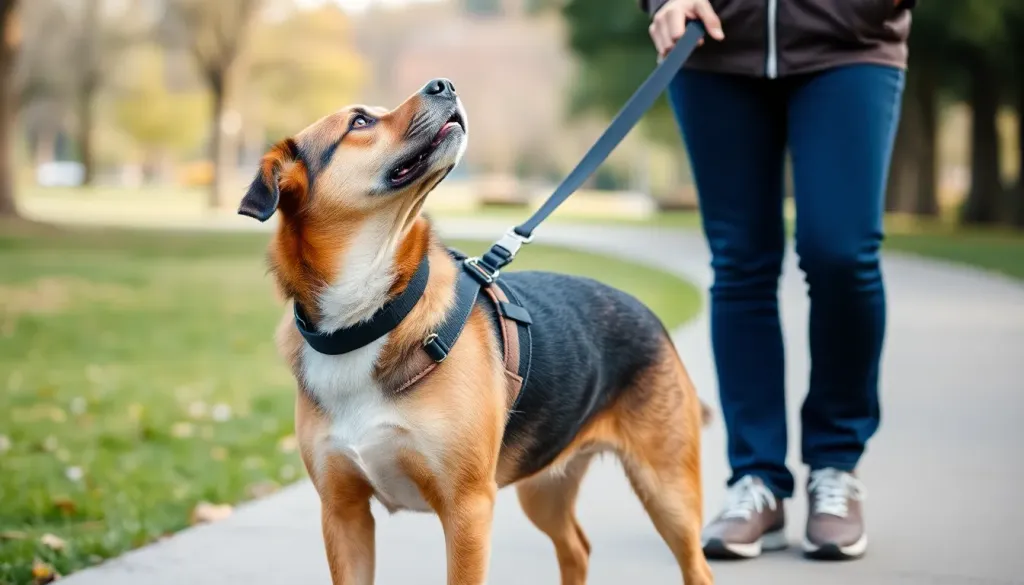
Step 4: Positive Reinforcement Training—Desensitization and Counter-Conditioning
This is the core of your training program. You’re teaching your dog that triggers predict amazing things rather than threats or frustration.
The Counter-Conditioning Protocol:
Phase 1: Establish the “Look at That” (LAT) Game
- In a controlled environment (your living room), place a mildly interesting object (a toy) across the room
- The moment your dog glances at it, mark with “Yes!” and deliver a high-value treat (chicken, cheese, hot dog—not regular kibble)
- Repeat until your dog looks at the object and immediately looks back at you for the treat
- Practice with increasingly interesting objects
- Take this game outside to a trigger-free environment
Phase 2: Apply LAT to Real Triggers at Distance
- Position yourself at your dog’s threshold distance where they notice the trigger but aren’t reacting
- The moment your dog looks at the trigger (another dog, person, etc.), mark “Yes!” and deliver multiple high-value treats in rapid succession
- Retreat: Move further away while continuing to reward
- Repeat: The pattern should be: Dog sees trigger → Treats appear → Trigger is no longer relevant
Critical Rule: If your dog is barking, lunging, or has hard eye contact (staring intensely), you’re too close! Increase distance immediately.
Phase 3: Gradual Exposure (Desensitization)
- Over multiple sessions (weeks to months), very gradually decrease the distance to triggers
- Decrease distance by only 2-3 feet per successful session—this isn’t a race!
- Some days you’ll need to increase distance again—that’s normal! Regression is part of the process
- Vary the intensity of triggers: start with calm, stationary dogs before moving to dogs in motion
The Science Behind It: According to classical conditioning principles (the same science behind Pavlov’s dogs), you’re creating a new emotional response. Previously: Trigger = Stress. Now: Trigger = Treats appearing. Eventually, your dog will feel happy when they see triggers because they predict good things.
Step 5: Teach Attention and Alternative Behaviors
“Look at Me” / Eye Contact Training
- Start indoors with zero distractions
- Say your dog’s name once
- The instant they make eye contact, mark “Yes!” and treat
- Practice until your dog whips their head toward you immediately when hearing their name
- Gradually add distractions: practice with TV on, in the backyard, in front of your house, then in low-distraction outdoor environments
- Use this as an emergency reorientation tool when triggers appear: “Fluffy!” → Dog looks at you → “Good! Let’s go!” and move away
“Find It” Scatter Game
- This creates a sniff-based activity that can redirect your dog’s attention and lower arousal
- When you need to create distance from a trigger, toss 5-10 treats into the grass and say “Find it!”
- Your dog’s nose goes down, their arousal decreases, and they’re actively engaged with you instead of the trigger
- Practice this skill in non-reactive situations first so it’s well-established when you need it
“Touch” or Hand Target
- Hold your palm out flat
- When your dog’s nose touches your hand, mark and treat
- This gives you a way to physically guide your dog’s head away from triggers and toward you
- You can use “Touch” repeatedly to keep your dog engaged as you pass by triggers
Step 6: Master Loose Leash Walking First
If your dog is constantly pulling even without triggers present, you’re starting at a disadvantage. Loose leash walking is the foundation for managing reactivity.
The Stop-and-Start Method:
- Start walking
- The moment your dog pulls and the leash becomes taut, stop moving completely—become a tree
- Wait silently (no corrections, no “No!”)
- The instant your dog releases tension and looks back at you or takes a step toward you, mark “Yes!” and resume walking
- If your dog stays at your side for even 2-3 steps, jackpot reward with multiple treats
- Gradually increase the number of steps required for rewards
Make Yourself More Interesting Than the Environment:
- Use unpredictable patterns: speed up, slow down, change direction
- Reward frequently when your dog is walking calmly (every 5-10 steps in the beginning)
- Talk to your dog in an upbeat, encouraging voice during walks
Step 7: Know When to Call in Professional Backup
You don’t have to do this alone! Some situations absolutely warrant professional guidance:
- Your dog has bitten or attempted to bite another dog or person
- Reactivity is worsening despite consistent training efforts
- Your dog shows signs of aggression in the home or other contexts
- You feel unsafe handling your dog during reactive episodes
- Your dog’s reactivity is severely limiting their quality of life
Who to Contact:
- Certified Professional Dog Trainer (CPDT-KA): Look for force-free, positive reinforcement trainers specializing in reactivity
- Veterinary Behaviorist (DACVB): Board-certified specialists who can prescribe behavior modification medications if needed
- Certified Applied Animal Behaviorist (CAAB): PhD-level professionals specializing in complex behavior cases
According to All Critters Veterinary Hospital, some dogs benefit from anti-anxiety medication during the training process—this isn’t “cheating,” it’s giving your dog the neurological capacity to learn new behaviors. Medication lowers anxiety enough that counter-conditioning can actually work.
Advanced Training Techniques: Taking It to the Next Level
Once your dog is successfully noticing triggers and looking to you for rewards at their threshold distance, you can introduce more advanced concepts:
Parallel Walking
- Arrange a controlled setup with a helper dog (a calm, non-reactive dog)
- Walk parallel to each other with significant distance between (50+ feet initially)
- Reward your dog continuously for maintaining calm behavior
- Over many sessions, gradually decrease the distance between dogs
- This teaches your dog that walking near other dogs = rewards and calm behavior
Engage-Disengage Pattern
- Allow your dog to briefly look at a trigger (engage)
- Call your dog’s attention back to you (disengage)
- Reward heavily for disengaging
- This builds impulse control and teaches your dog they can choose to look away from triggers
Premack Principle (Use Reactivity as Reward)
For dogs with frustration-based reactivity who want to greet other dogs:
- Require calm, polite behavior (sitting, looking at you) when they see a trigger
- IF the other owner consents and the other dog is appropriate, allow a brief, controlled greeting as the reward
- This teaches “calm behavior gets you what you want; exploding does not”
Common Training Mistakes to Avoid
Even with the best intentions, these pitfalls can sabotage your progress:
❌ Training Above Threshold
The Mistake: Trying to work on reactivity when your dog is already barking and lunging.
Why It Fails: Your dog’s brain is flooded with stress hormones and cannot learn. You’re just rehearsing reactive behavior.
The Fix: Always train at distances where your dog is calm. If you’re too close, retreat immediately.
❌ Using Punishment or Corrections
The Mistake: Yelling “No!”, yanking the leash, or using physical corrections when your dog reacts.
Why It Fails: Your dog associates the punishment with the trigger itself, making them more fearful and reactive. You’re saying “That dog over there causes bad things to happen to you.”
The Fix: Redirect and reward alternative behavior. Move away from triggers calmly.
❌ Inconsistency
The Mistake: Training intensively for a week, then taking two weeks off. Or allowing your dog to practice reactivity sometimes but not others.
Why It Fails: Behavior change requires consistent repetition and reinforcement. Intermittent rehearsal of reactivity makes it stronger.
The Fix: Commit to daily training sessions, even if they’re only 5-10 minutes. Short and consistent beats long and sporadic.
❌ Moving Too Fast
The Mistake: Decreasing distance to triggers too quickly because your dog did well once or twice.
Why It Fails: Reactivity training requires massive amounts of repetition at each level before progressing. One successful session doesn’t mean your dog is ready for the next level.
The Fix: Practice at each distance level for at least 10-15 successful repetitions (often over multiple days) before decreasing distance.
❌ Expecting Linear Progress
The Mistake: Getting discouraged when your dog has a bad day after several good days.
Why It Fails: Behavior change isn’t linear—expect zigzags! Bad days happen due to stress, environment changes, arousal levels, or just because.
The Fix: Accept setbacks as normal. On bad days, increase distance again and work at an easier level. You haven’t lost progress!
Creating a Long-Term Management Plan
Remember: You can do this! But it takes a structured approach. Here’s your sustainable plan:
Daily Training Components (20-30 minutes total)
- 5-10 minutes: Eye contact and attention training indoors
- 15-20 minutes: Structured walk focusing on loose leash walking and sub-threshold trigger exposure
- Optional evening session: “Find it” games or hand targeting practice to reinforce skills
Weekly Goals
- Week 1-2: Establish consistent attention and loose leash walking in low-distraction environments
- Week 3-4: Introduce sub-threshold trigger exposure; master the U-turn and retreat
- Week 5-8: Gradually decrease distance to triggers; practice LAT game extensively
- Week 9-12: Introduce brief parallel walking with helper dogs; maintain progress with variable reinforcement schedule
Monthly Assessment
Every 30 days, evaluate:
- Can your dog maintain attention on you at closer distances to triggers than last month?
- Has the intensity of their reactions decreased?
- Are you having more calm, enjoyable walks?
- What specific situations still need more work?
Maintenance Phase
Even after your dog shows significant improvement:
- Continue to reward calm behavior around triggers (though you can use a variable schedule—not every time)
- Avoid complacency—don’t deliberately test your dog by pushing them into situations they’re not ready for
- Have a “refresh” training session if you notice reactivity creeping back
Comprehensive FAQ: Your Reactivity Questions Answered
How long does it take to stop leash reactivity in dogs?
The timeline varies significantly based on the severity of reactivity, consistency of training, and your dog’s individual temperament. Patience is key!
Realistic Expectations:
- Mild reactivity (occasional barking at distant dogs): 6-12 weeks of consistent training often shows significant improvement
- Moderate reactivity (frequent lunging and barking): 3-6 months of dedicated training typically needed
- Severe reactivity (aggressive displays, attempted bites): 6-12+ months, often requiring professional intervention
The critical factor isn’t the calendar—it’s the number of quality training repetitions. A dog trained daily will progress faster than one trained sporadically. According to behavioral research, it can take 300-500 positive repetitions at each level before a new behavior becomes automatic.
Milestone Markers:
- 2-4 weeks: Dog begins to notice you’re changing your behavior; starts to look to you when triggers appear
- 6-8 weeks: Noticeable decrease in reaction intensity; longer periods of calm during walks
- 3-4 months: Dog can remain calm at significantly closer distances; alternative behaviors (eye contact, “find it”) become more automatic
- 6+ months: Sustained improvement with occasional setbacks; more walks are enjoyable than stressful
Remember: Some dogs will always need management strategies—complete reactivity “cure” isn’t always realistic or necessary. The goal is dramatically improved quality of life, not perfection!
Can an older dog overcome leash reactivity, or is it only treatable in puppies?
Absolutely yes—older dogs can learn new behaviors! While it’s true that preventing reactivity through proper puppy socialization is ideal, the saying “you can’t teach an old dog new tricks” is scientifically false.
Why Older Dogs Can Change:
- Dogs of all ages are capable of forming new neural pathways and learning through classical and operant conditioning
- Counter-conditioning works based on emotional response changes, not age
- Many older dogs actually have better impulse control than adolescents (ages 6 months to 2 years), making them easier to train in some ways
Special Considerations for Senior Dogs:
- Physical limitations: Ensure reactivity isn’t pain-related (arthritis, vision loss, hearing loss can make dogs more reactive). Work with your vet to rule out medical causes.
- Longer reinforcement history: An older dog may have been practicing reactivity for years, meaning more repetitions will be needed to change the behavior.
- Cognitive function: Dogs with canine cognitive dysfunction (doggy dementia) may struggle with new learning; consult a veterinary behaviorist.
According to certified trainers specializing in fearful dogs, some of their greatest success stories involve senior dogs who had been reactive their entire lives—with patience and consistency, dramatic improvements are possible at any age. You can do this, regardless of your dog’s age!
What’s the difference between leash reactivity and aggression?
This distinction is crucial because it affects how you approach training and whether your dog is actually dangerous:
Leash Reactivity:
- Definition: Explosive, defensive displays (barking, lunging, growling) that occur specifically when on leash but not in off-leash contexts
- Motivation: Fear-based or frustration-based; dog is trying to increase distance from a perceived threat OR trying to decrease distance to something they want but can’t reach
- Off-Leash Behavior: Same dog may be calm, playful, or avoidant (but not aggressive) when encountering triggers off-leash
- Bite History: Typically no actual bite incidents; displays are largely bluff behaviors
- Body Language: Often mixed signals—both approach and avoidance behaviors
True Aggression:
- Definition: Intent to cause harm; willingness to bite with or without a leash
- Motivation: Resource guarding, territorial behavior, predatory behavior, or redirected aggression
- Context: Aggressive displays occur in multiple contexts—not just on leash
- Bite History: May have a history of actual bites, attempted bites, or intensive bite sequences
- Body Language: More consistent—hard stares, stiff body, purposeful approach with intent
The Overlap: Some dogs display both reactivity and aggression, which is why professional evaluation is important if your dog has bitten or attempted to bite. PetMD emphasizes that leash reactivity alone doesn’t make a dog “aggressive”—most reactive dogs are simply scared or frustrated, not dangerous.
Safety Note: Even reactive dogs can bite if they feel cornered or if another dog/person makes physical contact during a reactive episode. Always prioritize safety and distance.
Should I let my reactive dog greet other dogs on leash?
In most cases, no—especially during the training process. This seems counterintuitive, but here’s why on-leash greetings usually make reactivity worse:
Why On-Leash Greetings Are Problematic:
- Leashes create tension: Both literally (physical tension on the leash) and figuratively (dogs can’t use normal greeting rituals like circling)
- No escape route: If the greeting goes badly, dogs can’t naturally retreat, leading to defensiveness
- Handler anxiety: Your stress travels down the leash, making your dog more tense
- Rehearses arousal: Even if the greeting goes “okay,” your dog practiced getting very excited when seeing other dogs—the opposite of what you want
- Unpredictable variables: You can’t control the other dog’s behavior, vaccination status, or the other owner’s handling skills
Exceptions:
- Controlled training scenarios with helper dogs specifically chosen for temperament
- After significant training progress with your dog demonstrating impulse control and calm behavior
- Frustration-based reactivity where greetings can be used as a reward for polite behavior (under professional guidance)
Better Alternatives:
- Arrange off-leash play dates in secure environments with known, compatible dogs
- Join a reactive dog class where controlled exposure happens with professional oversight
- Focus on neutral coexistence—teaching your dog that other dogs are simply part of the environment, not requiring interaction
The goal is teaching your dog that other dogs = boring and irrelevant, not exciting or scary. According to the ASPCA Professional’s training protocols, successful reactivity rehabilitation actually involves decreasing interest in other dogs during walks, not increasing socialization.
My dog is only reactive to certain types of dogs—how do I train for this?
Selective reactivity is actually very common and shows your dog is discriminating between different stimuli. This specificity can work to your advantage in training:
Common Selective Triggers:
- Size-based: Only reacts to large dogs or only to small dogs
- Color-based: Black dogs, dogs with certain coat patterns
- Energy-level based: Only reactive to running/playing dogs, calm with relaxed dogs
- Breed-specific: Herding breeds, bully breeds, etc.
- Gender-based: Only reacts to intact males or females
Training Strategy:
- Start with the easiest category first: If your dog is calm around small dogs but reactive to large dogs, do all your foundational counter-conditioning work with small dog triggers
- Build a success history: Get 50-100 successful repetitions with the easier trigger category
- Gradually introduce difficult triggers: Once your dog has mastered the easier category, very gradually introduce the difficult trigger type at extra distance
- Use hierarchy of difficulty:
- Level 1: Easier trigger type at distance
- Level 2: Easier trigger type up close
- Level 3: Difficult trigger type at great distance
- Level 4: Difficult trigger type at medium distance
- Level 5: Difficult trigger type at close distance
Practical Example:
If your dog is only reactive to large, dark-colored dogs:
- Week 1-4: Train around small dogs, all colors, until calm within 10 feet
- Week 5-6: Train around medium dogs, light colors, at 30+ feet
- Week 7-8: Train around large dogs, light colors, at 40+ feet
- Week 9-10: Train around medium dogs, dark colors, at 30+ feet
- Week 11-12: Train around large, dark dogs at 50+ feet
- Continue gradually working closer over months
This systematic desensitization approach prevents overwhelming your dog while building confidence. The skills learned with easier triggers do transfer to more difficult ones—but you still need to explicitly practice with the difficult category, starting from square one with distance.
Final Words of Encouragement: Your Training Journey Starts Now
Leash reactivity can feel isolating and frustrating—those judgmental looks from other dog owners, the dread you feel before walks, the embarrassment when your dog explodes. I see you, and I want you to know: You’re doing the right thing by learning how to help your dog.
Every single training session matters. Every time you create distance instead of pushing your dog over threshold, you’re making progress. Every treat you deliver when your dog looks at a trigger calmly is rewiring their brain. This works—but it requires consistency, patience, and compassion for both yourself and your dog.
Your Weekly Action Plan:
✅ This Week: Identify triggers, establish threshold distance, invest in proper equipment
✅ Next Week: Begin attention training indoors; practice U-turns and “let’s go” in low-distraction environments
✅ Weeks 3-4: Start sub-threshold trigger exposure; practice LAT game at maximum distance
✅ Month 2: Gradually decrease distance; introduce scatter feeding and hand targeting
✅ Month 3+: Continue systematic desensitization; consider joining a reactive dog class for added support
You can do this! Every reactive dog who now walks calmly past triggers started exactly where you are now. The journey is long, but the destination—peaceful walks with your best friend—is absolutely worth it. Trust the process, celebrate tiny victories, and remember: progress, not perfection!
Need professional support? Don’t hesitate to reach out to a certified trainer. You’re not alone in this, and you’re already proving what a dedicated, loving dog owner you are by seeking this information. Now go out there and change both your lives for the better—one training session at a time!