Stop Puppy Crate Whining at Night: 7 Tips

To stop puppy whining in a crate at night, establish a consistent bedtime routine, ensure all physical needs (potty, water, exercise) are met before crating, create positive crate associations through gradual training, and place the crate near your bedroom initially for comfort. This typically takes 1-3 weeks of consistent practice using positive reinforcement techniques, with most puppies learning to sleep quietly through the night when their needs are properly addressed.
⚠️ Training Disclaimer
The training advice in this article is based on established canine behavioral science and expert recommendations from certified trainers and veterinary behaviorists. However, every puppy is unique, and persistent behavioral issues may require consultation with a certified professional dog trainer (CPDT) or veterinary behaviorist. Never use punishment-based methods or leave a puppy crated for longer than their bladder control allows (generally one hour per month of age, plus one).
Understanding Why Your Puppy Whines in the Crate at Night
Before we tackle solutions, let’s understand the psychology behind the behavior. According to the American Kennel Club (AKC), puppy whining is a natural communication method—it’s how they tell you something’s wrong or they need help.
Common Reasons for Puppy Crying in Crate
Your puppy isn’t being stubborn or “bad.” Here’s what they’re actually communicating:
| Reason | What Your Puppy Needs | Typical Signs |
|---|---|---|
| Bathroom Emergency | Immediate potty break | Restless, circling, sniffing |
| Separation Anxiety | Gradual desensitization training | Panic-level crying, excessive drooling |
| Lack of Exercise | More physical/mental stimulation | High energy before bed, playful whining |
| Negative Crate Association | Positive reinforcement rebuilding | Resistance to entering, fearful body language |
| Genuine Discomfort | Temperature adjustment, better bedding | Scratching at floor, positional changes |
| Attention-Seeking | Consistent ignoring of demand behavior | Stops when you respond, restarts when ignored |
Key insight from dog psychology: Puppies under 16 weeks old are still developing object permanence and struggle with the concept that you still exist when they can’t see you. This developmental stage makes nighttime separation particularly challenging.
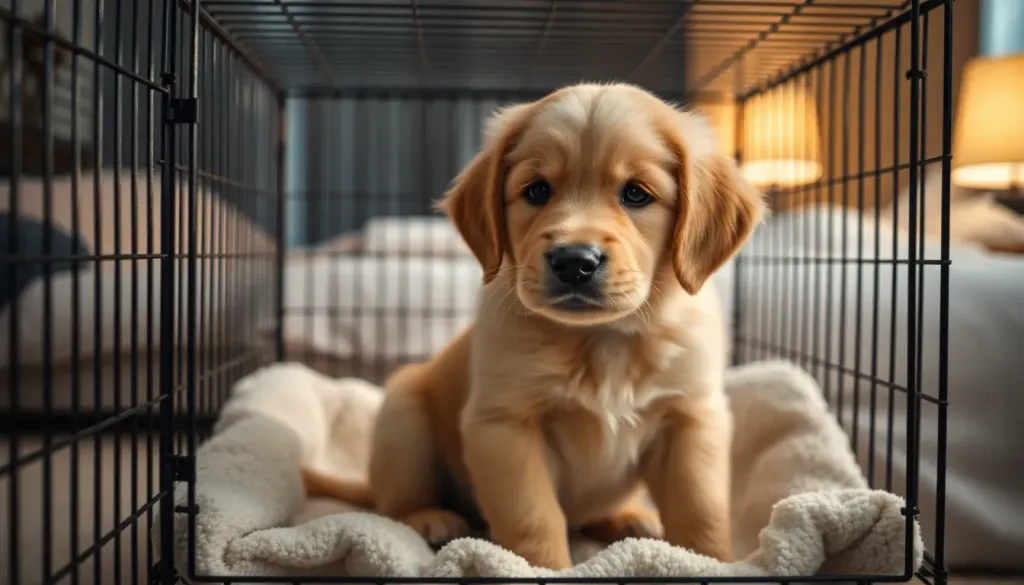
How to Stop Puppy Whining in Crate at Night: The Complete Training Protocol
Let’s get into the practical, step-by-step approach that actually works. This method combines classical conditioning (creating positive associations) with operant conditioning (reinforcing quiet behavior).
Step 1: Pre-Bedtime Preparation (The 2-Hour Window)
The foundation for quiet nights starts before your puppy enters the crate. PetMD emphasizes that meeting your puppy’s basic needs dramatically reduces nighttime whining.
Your 2-Hour Pre-Bedtime Checklist:
-
Exercise Session (30-45 minutes before bed)
- Age-appropriate play that tires them physically
- Mental stimulation through puzzle toys or training
- Example: 15 minutes of fetch + 15 minutes of “find the treat” games
- Why it works: Tired puppies sleep better (just like human babies!)
-
Final Meal (2-3 hours before bed)
- Avoid feeding too close to bedtime
- Prevents middle-of-night potty emergencies
- Remove water bowl 1 hour before crating (except in hot weather)
-
Potty Break Protocol
- Take your puppy out 5 minutes before crating
- Use a specific command: “Go potty” in a calm voice
- Wait until they eliminate—don’t go back inside too quickly
- Reward immediately with calm praise (not excitement)
-
Calm-Down Period (15-20 minutes)
- Dim lights, reduce household noise
- Gentle petting or quiet bonding time
- This transitions their energy from “play mode” to “sleep mode”
Step 2: Creating the Perfect Sleep Environment
Your puppy’s crate isn’t a cage—it’s their personal den. Here’s how to make it irresistible:
Crate Setup Checklist:
✓ Location matters: Place crate in your bedroom initially (within arm’s reach is ideal)
✓ Bedding: Soft, washable pad or blanket that smells like you
✓ Temperature control: Puppies can’t regulate body temperature well—ensure they’re warm but not hot
✓ Cover the crate: Drape a breathable blanket over 3 sides to create a “den” feeling
✓ Safe chew toy: One durable Kong or similar toy (no squeakers that stimulate)
✓ White noise: A fan or white noise machine masks household sounds
Pro tip from behavioral science: According to certified dog trainers, puppies sleep better when they can hear your breathing. This mimics the pack environment and reduces anxiety.
Step 3: The Gradual Crate Introduction Method
If your puppy already has negative associations with the crate, you need to reset their emotional response. This takes patience, but it’s worth it!
Week 1: Building Positive Associations
-
Day 1-2: Make the crate magical
- Feed all meals inside the crate (door open)
- Toss high-value treats randomly into the crate throughout the day
- Never force them inside—let them choose to enter
-
Day 3-4: Brief door closures
- Close door for 5 seconds while they eat
- Immediately open before they react
- Gradually increase to 30 seconds, then 1 minute
-
Day 5-7: Duration building
- Close door for 2-5 minutes while you’re in sight
- Ignore any whining—only open door during quiet moments
- Critical rule: NEVER open the crate while they’re whining (this rewards the behavior)
Week 2: Nighttime Application
-
First night protocol:
- Complete your pre-bedtime routine
- Place puppy in crate with calm energy (no fanfare)
- Use a specific cue word: “Bedtime” or “Kennel up”
- Ignore initial whining for 5-10 minutes
-
When to respond vs. ignore:
- IGNORE: Demand whining (starts/stops based on your attention)
- RESPOND: Urgent potty whining (sustained, escalating intensity after 10+ minutes)
- RESPOND: Signs of genuine distress (panic, excessive drooling, diarrhea)

Step 4: The Potty Break Decision Tree
Should I ignore puppy crying? This is the million-dollar question that confuses most new puppy parents. Here’s your decision framework:
Nighttime Crying Response Protocol:
Puppy starts whining
↓
Wait 3-5 minutes (set a timer—it feels longer than it is!)
↓
Still whining after 5 minutes?
↓
YES → Ask: "Could this be a potty need?"
  ├─ Puppy is under 12 weeks? → Likely potty break needed
  ├─ More than 4 hours since last break? → Likely potty break needed
  ├─ Drank water recently? → Likely potty break needed
  └─ If YES to any: Take out for potty (see protocol below)
↓
NO → Continue ignoring, they'll likely settle within 10-15 minutes
Potty Break Protocol (Avoiding Accidental Reward):
- Approach crate with zero eye contact or speaking
- Attach leash before opening door (prevents excited escape)
- Walk directly outside to potty spot
- Stand still, no interaction, repeat “Go potty” every 30 seconds
- If they eliminate: Calm praise (“Good potty”), immediately back to crate
- If no elimination after 5 minutes: Back to crate, no drama
- Never play, give treats, or engage during nighttime potty breaks
According to PetMD: Puppies under 12 weeks typically need 1-2 bathroom breaks per night. By 16 weeks, most can hold it for 6-7 hours with proper training.
Step 5: Troubleshooting Persistent Whining
You’ve followed all the steps, but your puppy still whines? Let’s dig deeper into advanced solutions.
Technique #1: The Gradual Distance Method
For puppies with separation anxiety:
- Week 1: Crate beside your bed, you can touch crate
- Week 2: Crate 3 feet from bed
- Week 3: Crate across room
- Week 4: Crate outside bedroom (if desired)
Move to next stage only when puppy settles quietly for 3 consecutive nights.
Technique #2: The “Cry It Out” Approach (With Limits)
This controversial method works ONLY if:
- All physical needs are met (potty, water, exercise)
- No signs of genuine distress or panic
- You can differentiate demand whining from distress
How to implement safely:
- Set a timer for 15 minutes after first whine
- Do not look at, speak to, or acknowledge puppy
- If whining continues past 15 minutes AND escalates → check for potty need
- If whining stops before 15 minutes → wait 5 minutes of silence, then calmly praise
You can do this! Most puppies reduce whining by 70% within 3 nights using this method when applied consistently.
Technique #3: Comfort Items That Actually Work
Research-backed comfort strategies from veterinary behaviorists:
| Comfort Item | How It Works | Best For |
|---|---|---|
| Snuggle Puppy | Heartbeat simulation mimics littermates | Puppies under 12 weeks |
| Your worn t-shirt | Your scent provides security | Anxious puppies |
| Frozen Kong | Mental distraction + soothing | Teething puppies (3-6 months) |
| Adaptil diffuser | Synthetic pheromones calm anxiety | High-anxiety puppies |
| Crate fan | White noise masks triggering sounds | Sound-sensitive puppies |
Important: Never use these as a “bribe” to enter the crate—they should already be inside as part of the normal setup.
The Science of Positive Reinforcement for Crate Training
Let’s talk behavioral psychology—because understanding WHY techniques work makes you a better trainer!
Classical Conditioning: Building Crate Love
Pavlov’s principles applied to crate training:
Before conditioning:
- Crate = Neutral or negative (isolation)
- Treats/meals = Positive (happiness)
During conditioning:
- Crate + Treats/meals paired together repeatedly
After conditioning:
- Crate alone = Positive emotional response
Practical application:
- Feed 100% of meals in crate for first month
- Give special long-lasting chews ONLY in crate
- Reserve highest-value treats (chicken, cheese) exclusively for crate
Timeline: Most puppies develop positive crate associations within 2-3 weeks of consistent pairing.
Operant Conditioning: Reinforcing Quiet Behavior
You must reward the behaviors you want and ignore those you don’t.
What to reinforce:
- ✅ Quiet settling in crate (even 10 seconds counts!)
- ✅ Voluntary crate entry
- ✅ Calm behavior when you approach crate
- ✅ Waking up without whining
How to reinforce:
- Mark the moment with “Yes!” or click
- Deliver treat through crate bars (or open and treat)
- Only reward during silence—never during or immediately after whining
What to ignore (extinction):
- ❌ Demand whining (attention-seeking)
- ❌ Pawing at crate door
- ❌ Barking/howling (when needs are met)
Patience is key! Extinction can cause an “extinction burst”—where behavior temporarily INCREASES before it decreases. If your puppy whines for 5 minutes typically, they might whine for 15 minutes the first night you ignore it. This is normal and means your training is working!
Common Mistakes That Make Whining Worse
Even experienced dog parents sometimes accidentally reinforce the wrong behavior. Avoid these training pitfalls:
Mistake #1: Inconsistent Responses
The problem: You ignore whining Monday night, respond on Tuesday, ignore Wednesday…
Why it fails: This creates a “variable reinforcement schedule”—the most powerful type of reinforcement in psychology. It teaches your puppy that persistence pays off.
The fix: Decide on your protocol (ignore vs. potty check) and be 100% consistent for at least 2 weeks.
Mistake #2: Dramatic Crate Entries/Exits
The problem: Making a big deal about bedtime with phrases like “Be a good boy!” or “I’ll be right back!”
Why it fails: Your energy communicates that being separated IS a big deal, increasing anxiety.
The fix: Calmly say “Bedtime,” puppy goes in, you turn and walk away. No eye contact, no emotional goodbye.
Mistake #3: Using the Crate as Punishment
The problem: “Go to your crate!” said with angry voice when puppy misbehaves.
Why it fails: Creates negative associations that override all positive training.
The fix: Never use crate for punishment. For timeouts, use a different space (bathroom, hallway with baby gate).
Mistake #4: Insufficient Daytime Crate Practice
The problem: Crate only used at night, so puppy associates it solely with separation.
Why it fails: No positive daytime experiences to build confidence.
The fix: Use crate for 3-4 short periods during the day (15-30 minutes) when you’re home and relaxed.
Mistake #5: Wrong Crate Size
The problem: Crate too large (puppy can potty in one end, sleep in other) or too small (uncomfortable).
Why it fails: Large crates eliminate the den instinct (dogs don’t soil their beds). Small crates create genuine discomfort.
The fix: Crate should allow puppy to stand, turn around, and lie down—nothing more. Use dividers as they grow.
Age-Appropriate Expectations for Puppy Crate Training
Your training timeline should match your puppy’s developmental stage. Unrealistic expectations cause frustration for both of you!
8-10 Weeks Old: The Foundation Stage
What’s realistic:
- 1-2 nighttime potty breaks (every 3-4 hours)
- 10-15 minutes of whining before settling initially
- May need crate within arm’s reach of your bed
Training focus:
- Positive associations only
- Very short crate sessions (5-10 minutes)
- Frequent potty breaks (every 1-2 hours during day)
Bladder control: Can hold bladder approximately 2-3 hours maximum
12-16 Weeks Old: Building Independence
What’s realistic:
- 1 nighttime potty break (around 3-4 AM)
- 5-10 minutes whining before settling
- Can begin moving crate farther from bed
Training focus:
- Extending crate duration to 3-4 hours
- Beginning separation from bedroom
- Practicing calm alone time during day
Bladder control: Can hold bladder approximately 4-5 hours maximum
4-6 Months Old: Near Independence
What’s realistic:
- No nighttime potty breaks needed (7-8 hour sleep)
- Minimal to no whining (under 5 minutes)
- Can sleep in different room if desired
Training focus:
- Solidifying quiet overnight behavior
- Longer daytime crate sessions (4-5 hours)
- Preparing for eventual freedom in house
Bladder control: Can hold bladder approximately 6-7 hours
6+ Months Old: Full Independence
What’s realistic:
- Sleeps quietly through night (8+ hours)
- Enters crate willingly
- Can begin transitioning to freedom in home
Training focus:
- Maintaining crate as safe space (not eliminating it)
- Gradual supervised freedom in house
- Using crate for management during training challenges
According to the AKC: Most puppies are fully crate trained (quiet overnight, voluntary entry) by 6-8 months with consistent training.
Advanced Comforting Techniques for Anxious Puppies
Some puppies have higher anxiety levels due to genetics, early experiences, or temperament. These puppies need extra support:
The “Heartbeat Buddy” Method
What it is: Placing a ticking clock or heartbeat toy near the crate
The science: Mimics the mother dog’s heartbeat, triggering calming instincts
Implementation:
- Use Snuggle Puppy or similar toy with heartbeat insert
- Warm toy in dryer for 2 minutes (mimics body heat)
- Place in crate during sleep time only (not during day)
- Gradually fade after 3-4 weeks
The “Gradual Departure” Protocol
For severe separation anxiety:
Week 1: Building tolerance in 30-second increments
- Puppy in crate, you sit beside it reading → Reward quiet
- Puppy in crate, you stand 3 feet away → Reward quiet
- Puppy in crate, you walk to doorway → Reward quiet
- Puppy in crate, you step outside room for 10 seconds → Reward quiet
Week 2: Extending duration
- Gradually increase out-of-sight time: 30 seconds, 1 minute, 2 minutes
- Return ONLY during quiet moments—never during whining
- Practice 5-10 times daily in short sessions
Week 3: Real-world application
- Apply to nighttime: You’re in bed but puppy can’t see you
- Move crate progressively farther from bed
- By end of week, crate can be in preferred location
You can do this! Even severe separation anxiety responds to patient, systematic desensitization. Progress may be slower, but it WILL happen with consistency.
Calming Supplements and Tools (When Training Needs Support)
Sometimes puppies need additional help while training progresses:
| Product | Active Ingredient | How It Works | When to Use |
|---|---|---|---|
| Adaptil Diffuser | Dog Appeasing Pheromone (DAP) | Synthetic version of mother dog’s calming pheromone | Mild to moderate anxiety |
| Zesty Paws Calming Bites | Chamomile, L-theanine | Natural anxiety reduction | Before bedtime routine |
| Thunder Shirt | Gentle pressure | Similar to swaddling in human babies | During crate training sessions |
| Rescue Remedy Pets | Flower essences | Stress relief (limited scientific support) | Acute stressful situations |
Important veterinary note: Always consult your vet before using supplements, especially for puppies under 12 weeks. Some products aren’t appropriate for very young puppies.
Potty Training Integration: The Overnight Success Formula
Crate training and potty training are interconnected. Master both simultaneously with this approach:
The Overnight Potty Schedule by Age
8-10 weeks:
- 10:00 PM: Final potty break + crate
- 1:00-2:00 AM: Potty break (set alarm—don’t wait for whining)
- 5:00-6:00 AM: Potty break
- 7:00 AM: Morning routine begins
11-14 weeks:
- 10:00 PM: Final potty break + crate
- 3:00-4:00 AM: Potty break (set alarm)
- 7:00 AM: Morning routine begins
15+ weeks:
- 10:00 PM: Final potty break + crate
- 7:00 AM: Morning routine begins (no night breaks needed)
Pro tip: Set your alarm before you expect your puppy to whine. This prevents them from learning that whining = getting out for potty.
Signs Your Puppy Genuinely Needs a Potty Break
Learn to differentiate “I need to potty” from “I want attention”:
Legitimate potty signals:
- Sudden escalation in crying intensity
- Circling or spinning in crate
- Sniffing or scratching at crate floor
- Restless pacing back and forth
- Whining that persists beyond 10-15 minutes consistently
Attention-seeking signals:
- Whining that stops/starts when you respond
- Playful barking or howling
- Pawing at crate door
- Whining that stops completely when ignored
- Calmer body language (lying down while whining)
When in doubt during the first 2 weeks: Take them out. Better safe than creating negative crate associations by forcing them to soil their sleeping space.
Week-by-Week Training Timeline: What to Expect
Let’s set realistic expectations for your training journey. Remember, every puppy is unique, but this timeline represents typical progress:
Week 1: Foundation and Adjustment
Expected behavior:
- 15-30 minutes of whining when first crated at night
- Needs 1-2 nighttime potty breaks
- May require your presence to settle
Your focus:
- Establishing consistent routine
- Building positive crate associations during day
- Meeting all physical needs before bed
Success markers:
- Puppy enters crate for meals willingly
- Whining decreases to under 20 minutes by end of week
- At least one night with only 10 minutes of whining
Week 2: Building Confidence
Expected behavior:
- 10-20 minutes of whining initially
- Still needs 1-2 nighttime potty breaks
- May begin settling faster
Your focus:
- Consistency in ignoring demand whining
- Practicing daytime crate sessions
- Differentiating potty needs from attention-seeking
Success markers:
- Whining under 15 minutes most nights
- Puppy shows neutral or positive body language near crate
- Successfully ignored some whining episodes without giving in
Patience is key! Week 2 might feel like you’re going backward—this is the “extinction burst” and it’s actually a sign of progress!
Week 3: Breakthrough Week
Expected behavior:
- 5-10 minutes of whining (or none)
- May drop to 1 nighttime potty break
- Settles more quickly overall
Your focus:
- Beginning to move crate away from bed (if desired)
- Extending quiet duration before reward
- Celebrating wins!
Success markers:
- At least 3 nights with under 10 minutes of whining
- Puppy seeks crate for naps during day
- Minimal resistance to bedtime routine
Week 4+: Mastery and Independence
Expected behavior:
- Minimal to no whining (under 5 minutes)
- Can sleep 6-8 hours without potty break (age-dependent)
- Voluntarily enters and settles
Your focus:
- Maintaining consistency
- Beginning supervised freedom outside crate during day
- Using crate for continued management as needed
Success markers:
- 5+ consecutive nights of quiet settling
- Puppy demonstrates relaxed body language in crate
- You feel confident in your training approach
You can do this! By week 4, most puppy parents report dramatic improvements. The hard work pays off!
The Role of Exercise and Mental Stimulation
Here’s a truth bomb: A tired puppy is a quiet puppy. Physical and mental exhaustion are your secret weapons.
Pre-Bedtime Exercise Guidelines by Age
8-12 weeks:
- 15-20 minutes of gentle play
- Focus: Controlled activities (no jumping, no long walks)
- Examples: Gentle tug, short fetch in yard, sniff exploration
3-4 months:
- 20-30 minutes of moderate play
- Focus: Building endurance gradually
- Examples: Interactive games, short leash walks (5-10 minutes), puzzle toys
5-6 months:
- 30-45 minutes of active play
- Focus: Age-appropriate exercise intensity
- Examples: Fetch, flirt pole, agility obstacles, training sessions
Rule of thumb: 5 minutes of exercise per month of age, twice daily (e.g., 4-month-old = 20 minutes morning + 20 minutes evening)
Mental Stimulation Activities (Brain Games Before Bed)
Mental exhaustion is twice as tiring as physical exercise! Try these:
-
Treat Scatter: Hide 10-15 treats around a room, let puppy sniff them out (10 minutes = 30 minutes of exercise)
-
Puzzle Feeders: Use Kong, snuffle mat, or puzzle toys for final meal (15-20 minutes of focused concentration)
-
Training Session: Practice 5-10 known commands with high-value rewards (10 minutes = significant mental fatigue)
-
“Find It” Game: Hide favorite toy while puppy waits, release to search (combines exercise + mental challenge)
-
New Trick Learning: Teach one new simple behavior each evening (shake, spin, touch)
Timing matters: Complete mental stimulation 1 hour before bed, then transition to calm bonding time.
Training Tools and Equipment That Actually Help
Let’s talk gear—what you actually need versus marketing hype:
Essential Crate Training Equipment
The crate itself:
- Wire crates: Best for most puppies (ventilation, visibility, collapsible)
- Plastic crates: Better for anxious puppies (more den-like)
- Size: Puppy should stand, turn, lie down comfortably—nothing more
- Divider panel: Essential for growing puppies (prevents potty accidents)
Must-have accessories:
- Waterproof crate pad (accidents will happen)
- Breathable crate cover (creates den environment)
- Two identical crate pads (one washing, one in use)
- Enzymatic cleaner for accidents (regular cleaners don’t eliminate odor)
Nice-to-have accessories:
- Crate-mounted water bowl (for longer sessions, not overnight)
- Snuggle Puppy with heartbeat (anxiety reduction)
- White noise machine (masks household sounds)
- Baby monitor (lets you observe without puppy seeing you)
Products to Avoid
❌ Pee pads in crate: Teaches puppy it’s okay to potty in sleeping space
❌ Shock or spray collars: Cruel and create fear-based associations
❌ Crate too large without divider: Allows potty in one end, sleep in other
❌ Plush toys with stuffing: Choking hazard when unsupervised
❌ Blankets for young puppies: Can bunch up and cause suffocation risk
Addressing Special Circumstances and Challenges
Real life isn’t always textbook perfect. Let’s troubleshoot unique situations:
Challenge #1: Rescue Puppies with Unknown History
The situation: You adopted a puppy with possible negative crate experiences.
Modified approach:
- Start completely over: Assume zero crate training—never force
- Slower timeline: Double the duration of each training phase
- Extra high-value rewards: Real chicken, cheese, special toys ONLY for crate
- Consider alternatives initially: Exercise pen with crate door open inside it
- Professional help: Consider consulting certified trainer if signs of trauma
Signs of trauma to watch for:
- Urinating/defecating when approaching crate
- Extreme panic (breaking teeth, bleeding paws trying to escape)
- Complete freeze response when near crate
- Regression after initial progress
Important: True crate trauma may require professional behavioral intervention. Don’t hesitate to seek expert help.
Challenge #2: Multi-Dog Households
The situation: You have an older dog and new puppy—how to manage crate training?
Best practices:
- Separate crates: Each dog needs their own space
- Different locations initially: Prevent older dog from interfering with puppy settling
- Quiet older dog first: Put older dog in crate before puppy (models behavior)
- Reward both: When puppy settles quietly, reward older dog too (teaches quiet = good things)
- Gradual proximity: Move crates closer over weeks as puppy learns
Common mistake: Letting older dog “comfort” whining puppy—this rewards whining behavior!
Challenge #3: Apartment Living with Noise Concerns
The situation: You’re worried about neighbors complaining during training.
Strategies:
- Proactive communication: Let neighbors know you’re training a puppy, it’s temporary
- Strategic timing: Begin training on weekend when you can respond quickly
- Extra soundproofing: White noise, TV on low volume, fan
- Consider location: Place crate on wall not shared with neighbors
- Shorter training periods: More frequent brief sessions vs. extended crying
Alternative approach: Train in bathroom or closet initially (smaller, more den-like, insulated)
Challenge #4: Working Schedule Complications
The situation: You work early mornings or late nights—how to maintain consistency?
Solutions:
- Adjust bedtime: Crate time should allow for 8 hours of puppy sleep + your wake-up routine
- Set multiple alarms: Don’t skip nighttime potty breaks due to being tired
- Weekend intensive training: Focus heavily on training during days off
- Consider doggy daycare: 2-3 days per week helps with socialization and exercise
- Puppy sitter: Hire someone for midday break and exercise if needed
Remember: First 3 months are most intensive—ask for help from friends/family if needed!
The Truth About “Crying It Out”: When It’s Appropriate
This topic generates heated debate in dog training communities. Let’s discuss the nuance with science-backed guidance.
When Ignoring Whining IS Appropriate
The conditions must ALL be met:
✅ Puppy is at least 12 weeks old
✅ All physical needs are met (recent potty, not hungry/thirsty, comfortable temperature)
✅ Puppy has positive daytime crate associations
✅ No signs of panic or extreme distress
✅ You can differentiate demand whining from genuine need
✅ You’ve ruled out medical issues (pain, illness)
The timeframe: 15-20 minutes maximum of ignoring before reassessing
The method:
- Set timer for 15 minutes
- Absolutely zero acknowledgment (no looking, speaking, moving toward crate)
- If whining continues past 15 minutes AND escalates → evaluate for potty need
- If whining stops at any point → wait 5 minutes of silence before any interaction
When Ignoring Whining is NOT Appropriate
Never ignore if:
❌ Puppy under 10 weeks old (too young for bladder control)
❌ Signs of panic (excessive drooling, bloody paws from scratching, vomiting)
❌ Puppy has had negative crate experiences
❌ More than 3-4 hours since last potty break
❌ Medical issues present (diarrhea, urinary problems)
❌ You haven’t done daytime crate training yet
Alternative approach: If you can’t appropriately ignore, you need to revisit daytime crate training foundation before attempting overnight.
FAQ: Your Most Common Crate Training Questions Answered
How long will my puppy cry in the crate at night?
Detailed answer: Most puppies cry for 15-30 minutes the first few nights, decreasing to 10-15 minutes by the end of week one, and under 10 minutes by week two with consistent training. By week three to four, most puppies settle within 5 minutes or without any whining at all.
However, this timeline depends on several factors:
- Age: Younger puppies (8-10 weeks) take longer than older puppies (14-16 weeks)
- Consistency: Responding inconsistently extends the timeline significantly
- Daytime practice: Puppies with extensive positive daytime crate exposure adapt faster
- Individual temperament: Some puppies are naturally more independent, others more anxious
- Previous experiences: Rescue puppies or those with negative associations take longer
According to veterinary behaviorists, if your puppy still cries extensively (over 20 minutes) after three weeks of consistent training, consult a professional trainer to rule out separation anxiety or other behavioral issues.
Action steps if progress is slower than expected:
- Increase daytime crate sessions to 6-8 short periods
- Ensure